

Current events
Next talk on Tuesday in 4 days by Corinne Steiner.
News 10.07.2026
Visit by Ludger Wirtz and Atharv Maheshwari
Site Content:
29.09.2014
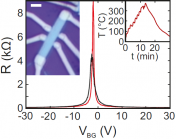
New publication: Impact of thermal annealing on graphene devices encapsulated in hexagonal boron nitride
Physica Status Solidi B (online)
We present a thermal annealing study on single-layer and bilayer (BLG) graphene encapsulated in hexagonal boron nitride. The samples are characterized by electron transport and Raman spectroscopy measurements before and after each annealing step. While extracted material properties such as charge carrier mobility, overall doping, and strain are not influenced by the annealing, an initial annealing step lowers doping and strain variations and thus results in a more homogeneous sample. Additionally, the narrow 2D-sub-peak widths of the Raman spectrum of BLG, allow us to extract information about strain and doping values from the correlation of the 2D-peak and the G-peak positions.

16.09.2014
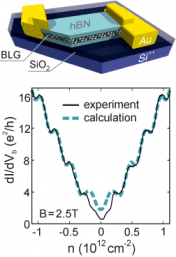
New publication: Limitations to carrier mobility and phase-coherent transport in bilayer graphene
Phys. Rev. Lett. 113, 126801 (2014)
We present transport measurements on high-mobility bilayer graphene fully encapsulated in hexagonal boron nitride. We show two terminal quantum Hall effect measurements which exhibit
full symmetry broken Landau levels at low magnetic fields. From weak localization measurements, we extract gate-tunable phase coherence times τφ as well as the inter- and intra-valley scattering times τi and τ∗. While τφ is in qualitative agreement with an electron-electron interaction mediated dephasing mechanism, electron spin-flip scattering processes are limiting τφ at low temperatures. The analysis of τi and τ∗ points to local strain fluctuation as the most probable mechanism for limiting the mobility in high-quality bilayer graphene.
14.09.2014
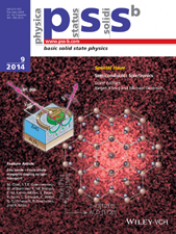
Cover Page: Zinc oxide –From dilute magnetic doping to spin transport (Phys. Status Solidi B 9/2014)
Phys. Status Solidi B (2014)
The front cover schematically shows three important aspects of the experiments. First, the lattice mismatch between ZnO and Al2O3 is reduced by rotating the ZnO lattice by 30°. Second, dilute magnetic doping with cobalt results in phase segregation and the formation of nanometer-sized metallic clusters, as indicated via the bright red contrast of the energy-filtered TEM image (background). Third, the sketched device allows for studying spin transport properties. A spin-polarized current from a magnetic Co electrode is injected into ZnO, and the spin polarization is determined optically via the polarization of reflected photons.
The source files for the front cover image were prepared by Matthias Althammer.
04.09.2014
Christoph Stampfer honoured as Young Scientist by World Economic Forum

Christoph Stampfer has been selected and honoured as one of the “30 exceptional scientists under the age of 40” in the 2014 World Economic Forum.
Professor Christoph Stampfer has been selected as a Young Scientist by the World Economic Forum, recognizing his “expertise and thought leadership” in the field of Experimental Physics. The appointment comes with an exclusive invitation to this year’s Annual New Champions meeting in Tianjin, China, alongside leading figures in business and politics.
Each year, the World Economic Forum selects 30 exceptional scientists below the age of 40 to participate alongside business and political leaders in the Annual Meeting of the New Champions in China. The winners are scientists chosen world-wide, representing a wide range of disciplines. The selected “Young Scientists” bring value to the Annual Meeting by “contributing their scientific perspective and delivering the most up-to-date trends from various fields of science.”
For more information please see
http://www.weforum.org/news/world-economic-forum-honours-its-2014-young-scientists-community-annual-meeting-new-champions.
04.04.2014
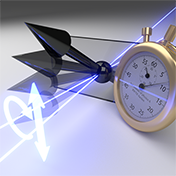
New publication: Unambiguous determination of spin dephasing times in ZnO
Phys. Status Solidi B (2014)
Time-resolved magneto-optics is a well-established optical pump–probe technique to generate and to probe spin coherence in semiconductors. By this method, spin dephasing times T2* can easily be determined if their values are comparable to the available pump–probe delays. If T2* exceeds the laser repetition time, however, resonant spin amplification (RSA) can equally be used to extract T2* image. We demonstrate that in ZnO these techniques have several tripping hazards resulting in deceptive values for T2* and show how to avoid them. We show that the temperature dependence of the amplitude ratio of two separate spin species can easily be misinterpreted as a strongly temperature-dependent T2* of a single spin ensemble, while the two spin species have T2* values, which are nearly independent of temperature. Additionally, consecutive pump pulses can significantly diminish the spin polarization, which remains from previous pump pulses. While this barely affects T2* values extracted from delay line scans, it results in seemingly shorter inline image values in RSA.