

Current events
Next talk on Tuesday in 5 days by Corinne Steiner.
News 10.07.2026
Visit by Ludger Wirtz and Atharv Maheshwari
Site Content:

08.11.2014
Poster prize for Tymofiy Khodkov
Tymofiy Khodkov won the 2nd poster prize at the JARA-FIT Science Days 2014 in Schleiden. Congratulation!

30.10.2014
New publication: Random Strain Fluctuations as Dominant Disorder Source for High-Quality On-Substrate Graphene Devices
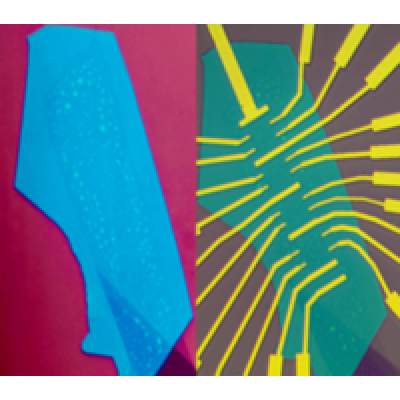
Phys. Rev. X 4, 041019 (2014)
We perform systematic investigations of transport through graphene on hexagonal boron nitride (hBN) substrates, together with confocal Raman measurements and a targeted theoretical analysis, to identify the dominant source of disorder in this system. (more)
24.10.2014
New publication: Raman spectroscopy on mechanically exfoliated pristine graphene ribbons
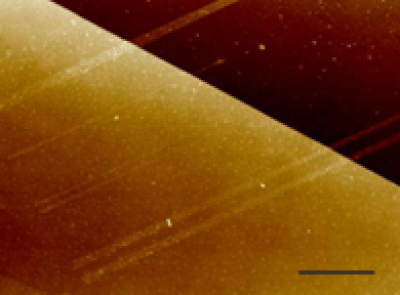
Physica Status Solidi B (online)
We present Raman spectroscopy measurements of non-etched graphene nanoribbons, with widths ranging from 15 to 160 nm, where the D-line intensity is strongly dependent on the polarization direction of the incident light. The extracted edge disorder correlation length is approximately one order of magnitude larger than on previously reported graphene ribbons fabricated by reactive ion etching techniques. This suggests a more regular crystallographic orientation of the non-etched graphene ribbons here presented. We further report on the ribbons width dependence of the line-width and frequency of the long-wavelength optical phonon mode (G-line) and the 2D-line in the studied graphene ribbons.
08.10.2014
New publication: Nanosecond Spin Lifetimes in Single- and Few-Layer Graphene–hBN Heterostructures at Room Temperature
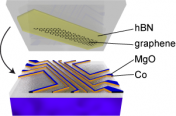
Nano Lett. 14, 6050 (2014)
We present a new fabrication method of graphene spin-valve devices that yields enhanced spin and charge transport properties by improving both the electrode-to-graphene and graphene-to-substrate interface. First, we prepare Co/MgO spin injection electrodes onto Si++/SiO2. Thereafter, we mechanically transfer a graphene–hBN heterostructure onto the prepatterned electrodes. We show that room temperature spin transport in single-, bi-, and trilayer graphene devices exhibit nanosecond spin lifetimes with spin diffusion lengths reaching
03.10.2014
New publication: Suppression of contact-induced spin dephasing in graphene/MgO/Co spin-valve devices by successive oxygen treatments
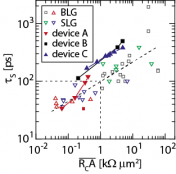
Phys. Rev. B 90, 165403 (2014)
By successive oxygen treatments of graphene nonlocal spin-valve devices we achieve a gradual increase of the contact-resistance–area products (RcA) of Co/MgO spin injection and detection electrodes and a transition from linear to nonlinear characteristics in the respective differential dV−dI curves. With this manipulation of the contacts, both spin lifetime and the amplitude of the spin signal can significantly be increased by a factor of seven in the same device. This demonstrates that contact-induced spin dephasing is the bottleneck for spin transport in graphene devices with small RcA values. With increasing RcA values, we furthermore observe the appearance of a second charge neutrality point (CNP) in gate-dependent resistance measurements. Simultaneously, we observe a decrease of the gate voltage separation between the two CNPs. The strong enhancement of the spin-transport properties as well as the changes in charge transport are explained by a gradual suppression of a Co-graphene interaction by improving the oxide barrier during oxygen treatment.