

Current events
Next talk on Friday in 2 days by Yeganeh Mirzanejad.
News 10.07.2026
Visit by Ludger Wirtz and Atharv Maheshwari
Site Content:
03.05.2022
New publication: Visualisierung von Messdaten eigener Sensormodule mit phyphox (in German)
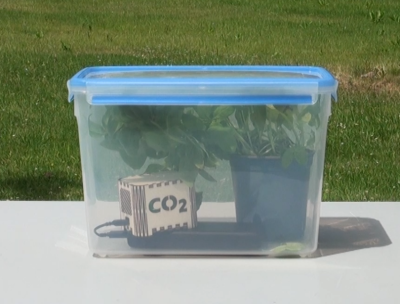
In this German publication we demonstrate how the phyphox BLE library for Arduino can be used to easily visualize data from a custom build sensor on your smartphone. We use CO2 sensor kits as an example, which have been designed as an assembly kit for schools during the pandemic. But besides being a tool to monitor air quality, the easy visualization with phyphox allows for more advanced uses in STEM classes, with experiments in Biology, Chemistry and of course Physics.

31.03.2022
New publication: Using a Smartphone pressure sensor as Pitot tube speedometer
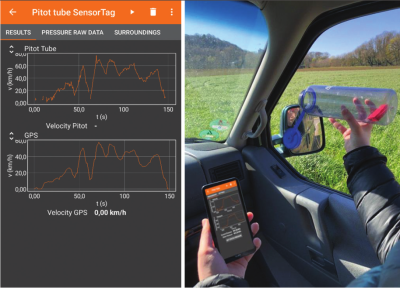
As smartphones have become a part of our everyday life, their sensors have successfully been used to allow data acquisition with these readily available devices in a variety of different smartphone-based school experiments. Such experiments most commonly take advantage of the accelerometer and gyroscope. A less frequently used sensor in smartphone-based experiments is the pressure sensor or barometer. Pressure sensors in smartphones can improve indoor navigation, for example in multi-story shopping malls. In a popular smartphone experiment, the barometer is used to determine the current altitude in an elevator with the barometric height formula. Along with accelerometer data and by deriving the height data to calculate the velocity, z(t), v(t), and a(t) plots can be generated and shown to students in real time.
18.03.2022
Short group excursion
Walked from the Kronenberg through the Aachenerwald to the Gut Entenpfuhl and played a round of mini-golf there. The weather was more than fine and being outside is always great.

21.02.2022
Quanteen Day 2022
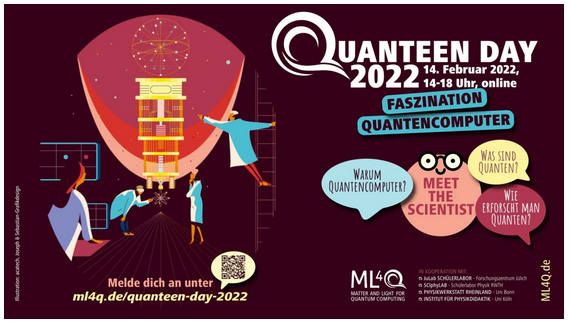
Unter dem Motto 'Faszination Quantencomputer' fand am 14.02.22 der von ML4Q organisierte Quanteen day statt. Hierbei konnten interessierte Schüler:innen in Impulsvorträgen mehr über die Physik hinter Quantencomputern erfahren und anschließend Einblicke in den Alltag von Doktorand:innen bekommen, die in diesem Feld forschen. Von unserem Institut mit dabei waren auch Annika Kurzmann und Corinne Steiner, die bei einer virtuellen Labortour Einblicke in ihre Forschung gegeben haben.
12.02.2022
New book chapter: "Überwachte Rollbewegung mit phyphox"
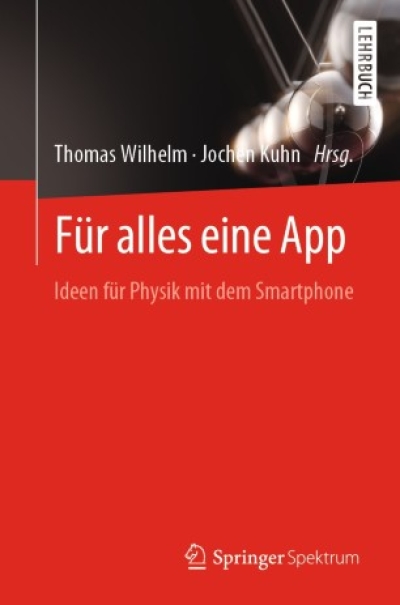
German only – Sebastian Staacks und Christoph Stampfer tragen mit einem Kapitel „Überwachte Rollbewegung mit phyphox“ zu dem neuen Buch „Für alles eine App - Ideen für Physik mit dem Smartphone“ von Thomas Wilhelm und Jochen Kuhn (Springer 2022) bei.
12.02.2022
Phyphox in the RWTH alumni magazine
We have contributed an article with a bit of project history to this term's RWTH alumni magazine.
15.12.2021
New publication: Probing Two-Electron Multiplets in Bilayer Graphene Quantum Dots
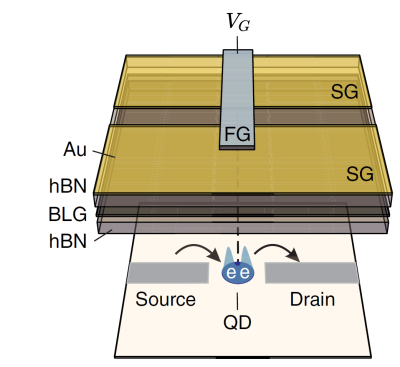
Phys. Rev. Lett. 127, 256802(2021) We report on finite bias spectroscopy measurements of the two-electron spectrum in a gate defined bilayer graphene (BLG) quantum dot for varying magnetic fields. The spin and valley degree of freedom in BLG give rise to multiplets of six orbital symmetric and ten orbital antisymmetric states. We find that orbital symmetric states are lower in energy and separated by ≈ 0.4–0.8 meV from orbital antisymmetric states. The symmetric multiplet exhibits an additional energy splitting of its six states of ≈ 0.15–0.5 meV due to lattice scale interactions. The experimental observations are supported by theoretical calculations, which allow to determine that intervalley scattering and “current-current” interaction constants are of the same magnitude in BLG.
03.12.2021
New publication: Triggering phase-coherent spin packets by pulsed electrical spin injection across an Fe/GaAs Schottky barrier
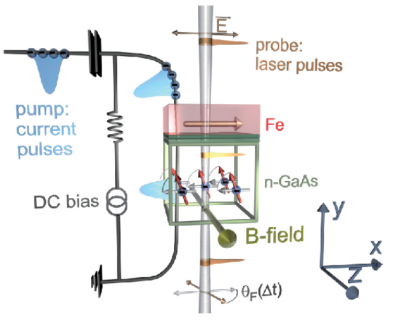
Phys. Rev. B 104, 195202 (2021) The precise control of spins in semiconductor spintronic devices requires electrical means to generate spin packets with a well-defined initial phase. We demonstrate a pulsed electrical scheme that triggers the spin ensemble phase in a similar way as circularly polarized optical pulses generate phase coherent spin packets. Here, we use fast current pulses to initialize phase coherent spin packets, which are injected across an Fe/GaAs Schottky barrier into n-GaAs. By means of time-resolved Faraday rotation, we demonstrate phase coherence by the observation of multiple Larmor precession cycles for current pulse widths down to 500 ps at 17 K. We show that the current pulses are broadened by the charging and discharging time of the Schottky barrier. At high frequencies, the observable spin coherence is limited only by the finite bandwidth of the current pulses, which is of the order of 2 GHz. These results therefore demonstrate that all-electrical injection and phase control of electron spin packets at microwave frequencies is possible in metallic-ferromagnet–semiconductor heterostructures.